Inside the high-stakes realm of contemporary pro-level sliding, success is far more than exclusively a product of sheer horsepower or pilot bravado. Conversely, it has evolved into a multifaceted science which necessitates a painstaking blend of picking a time-tested chassis, equipping it with the highest-quality competition hardware, and, most importantly, understanding its live characteristics on the course through sophisticated drift telemetry software. This exhaustive handbook will serve as your roadmap starting from the very first concept of a drift build through to the last data-informed tweaks that turn a capable machine into a consistent podium finisher. We will thoroughly explore the precise engineering of chassis dynamics adjustment, showing how a state-of-the-art suspension tuning tool like GripDial eliminates approximation and provides unmatched clarity into your vehicle's real-world performance.
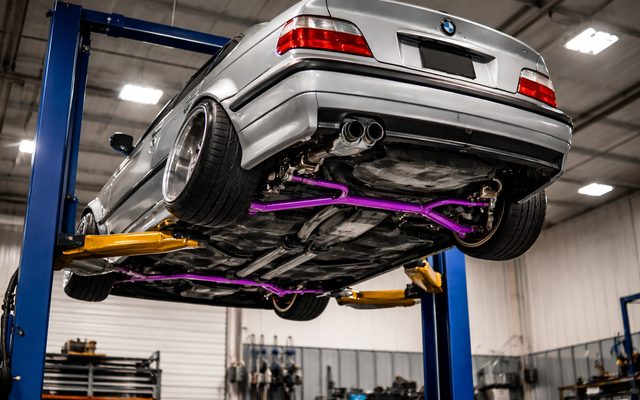
The foundation of any great competitive sliding vehicle is, indisputably, the base vehicle itself. Certain vehicles have earned renowned status within the worldwide oversteer community due to their built-in balance, strong build quality, and the vast availability of aftermarket parts available. Picking the optimal platform is the initial and most significant choice a enthusiast will make. To illustrate, the BMW E36 is commonly accepted as among the greatest all-around cars for drifting of the modern era. Its excellent 50/50 weight distribution, alongside a RWD setup and extremely reliable six-cylinder powerplants, establishes a chassis that is both easy to handle for newcomers and incredibly competitive in the possession of a expert pilot. The next step of this lineage, the BMW E46, builds upon these qualities with a increasingly sophisticated structure, broader track for greater stability, and even increased lock directly from the factory. A different formidable platform in the top-level scene is the Corvette C6.
This American track weapon offers a distinctive combination of benefits to the sliding sport, including a light aluminum frame, a rear-mounted drivetrain component that helps create an ideal weight distribution, and the immense torque of a powerful LS-series V8 engine. This combination makes it an absolute weapon on track, able of entering and sustaining continuous drifts with relatively effortless application of throttle. For drivers looking for exceptional performance per dollar, the 350Z model Nissan stands out as a top-tier candidate. It comes from the manufacturer with a stiff body structure, a decent OEM LSD, and the responsive VQ series powerplant that offers sufficient performance for practicing and advancing in the discipline. Its newer version, the Nissan Z34, brings more improvements in body strength, suspension design, and outright engine output, cementing its place as a favorite selection among serious drivers. Other historic vehicles that warrant mention encompass the nimble rotary-powered Mazda FC RX-7, the most popular S13 Silvia/240SX, the American SN95 generation Mustang, the electronic-equipped BMW E90, and the compact yet unbelievably playful and forgiving MX-5 Miata. Each of these cars gives a different palette of traits, difficulties, and capabilities, but they all have in common the core components required to serve as a capable sliding vehicle.
However, picking the correct car is merely the beginning. To access the full potential of any of these cars, major modifications to the steering and damping and springing systems are completely mandatory. This is where the domain of precision drift-spec parts becomes sharp importance. The one most transformative modification for a serious competition vehicle is the installation of a drift-spec angle modification kit. These sophisticated kits, for example those manufactured by specialist companies like specialist manufacturers, are designed to radically expand the vehicle's available steering angle. A standard production vehicle is highly restricted in how far its tires can pivot, a engineering limitation for daily driving. In sliding, but, aggressive opposite lock is frequently required to catch and maintain a angle. An angle kit substitutes the stock uprights, tie rods, and often control arms with components that permit the wheels to attain angles over 70 or even 80 degrees, as opposed to a normal OEM angle of around 40 to 50 degrees.
This tremendously greater steering angle gives the driver with dramatically more command during a drift, allowing it to be far simpler to begin a slide, sustain it through a sweeping corner, and switch seamlessly from one direction to the other. The contrast in handling is truly revolutionary. Coupled with a appropriately specified modification is the every bit as critical upgrade to the car's suspension. Generic or even expensive street adjustable suspension are just not intended for the unique and brutal needs of competitive oversteer. A purpose-built system of coilovers is crucial. These specific dampers have specific piston tuning and spring stiffness that are designed for the rapid load shifting that is characteristic of aggressive driving. When a operator begins a angle, the vehicle's weight is thrown violently to the outer of the corner. Optimal competition dampers handle this transfer in a controllable way, enabling the chassis to find its balance rapidly and giving the pilot precise response through the steering wheel and seat. They furthermore allow for exact adjustment of ground clearance, shock absorber stiffness, and cross-weight, which are all key elements of fine-tuning the car's dynamics to a specific venue or piloting technique. Together, a high-quality steering angle kit and a expertly specified set of drift-spec adjustable dampers are the absolute hardware base upon which all future refinement is constructed.
Once the essential components is in place, the next vital step in the build is the detailed adjustment of the car's wheel angles. This is the world of car suspension tuning, a methodology that can feel overwhelmingly complex to the beginner but is, in practice, the defining factor to converting a assembly of fast pieces into a unified and controllable vehicle. The most critical element of suspension geometry for drifting is undoubtedly camber angle. Camber angle is the tilt of the tire in relation to the vertical line when viewed from the front of the chassis. When the upper part of the tire is leaning towards the car, this is referred to as negative camber. For sliding, an inward tilt on the front tires is universally employed and is considered critical. The reason is drift telemetry software fundamentally linked to vehicle dynamics.
When a chassis is going around a bend at high sideways angles, the chassis tilts to the external of the turn. This body roll makes the outer steering tire to diminish its ideal footprint with the asphalt. By applying an inward tilt, the wheel is pre-tilted to counteract this tilt. As the car rolls into the bend, the tire gains a better contact patch with the track, increasing its grip at the precise time when it is most required for control. Typically, front adjustments for a serious sliding vehicle range from approximately -3 degrees to as much as -5 degrees or even more, based on the details of the car setup, tire selection, and driver style. The rear axle tires also employ inward tilt, but the values are generally more conservative and less aggressive than the front axle. Too much camber at the rear can result in the chassis overly loose and challenging to control on throttle use, as it shrinks the usable tire footprint of the driving wheels during linear power delivery. Thus, rear adjustments are frequently in the ballpark of -1 degree to -3 degrees, finding a precise balance between offering adequate cornering grip to help in starting and sustaining the angle while simultaneously maintaining usable traction for power-down the corner. Camber is just one part of the larger tuning puzzle, which additionally involves toe, caster angle, and bump steer modification.
Toe setting is the orientation of the wheels when looked at from a bird's-eye view. Toe-in means the front edges of the wheels are closer together than the trailing edges, while outward toe means the converse. For oversteer, a small amount of front toe-out is commonly employed to sharpen the turn-in steering response, making the car feel more agile and eager to start a drift. Rear toe is usually set to neutral or a incredibly small amount of positive toe to encourage predictability under power. self-centering is the forward or backwards tilt of the kingpin axis when looked at from the side of the car. Positive caster enhances self-centering and high-speed confidence, and it additionally increases camber gain during turning, which is very useful. Tuning these settings is a complex interaction where a change to one setting can and often will affect the remaining parameters. The old-school approach for tuning a car's suspension geometry for drifting has for a long time been a tedious affair of trial and error. A tuner or crew would introduce a change based on experience, test the car on track, rely on the driver's subjective perception and feedback, and then introduce a further adjustment. This loop would continue over and over until the vehicle felt "right" or the scheduled practice period ran out. This system is not just extremely wasteful in terms of time and tires, fuel, and parts, but it is additionally inherently imprecise.
Pilot sensation is a notoriously subjective data source, influenced by countless factors such as fatigue, evolving track grip levels, temperature, and merely the focus of the driver on that specific day. What feels "oversteery" on one run might feel "pushing" on the next run, causing contradictory feedback and ineffective tweaks. This long-standing limitation in car suspension tuning is precisely where modern engineering tools has stepped in to revolutionize the process.
The development and integration of advanced suspension tuning applications has introduced a new paradigm for tuning and refining professional drift cars. This new generation of tools, exemplified by cutting-edge solutions like data acquisition tools, function by actively measuring the real-time dynamic behavior of the chassis as it is piloted on the track. As opposed to relying on personal impression, these devices acquire quantifiable data on critical variables such as shock absorber movement, corner velocities, acceleration forces, steering angle, and driver input input. This raw information flow is then interpreted by advanced software that can visualize and interpret the metrics in a comprehensible format. For the first time, engineers and teams can see precisely what the chassis is performing at every point of a lap. This ability transforms the entire suspension tuning procedure. Consider the particular challenge of dialing in the front axle negative camber for a given chassis. As an alternative to making a modification from -3 degrees to -3.5 degrees and then driving several runs to try and "perceive" a improvement, a telemetry system can provide immediate and definitive data. The application can indicate in a chart how the wheel's loading is performing during the most important moments of a slide: turn-in, mid-corner, and changing direction. It can show if the present angle is enabling the steering tire to achieve ideal loading or if the rubber is over-stressed on its external edge.
The system can after analysis make fact-based advice for modification. Perhaps the data reveals that the tire is even overloading its outer shoulder at -3.5 degrees of negative camber, indicating that even more negative camber, say -4 degrees, might be advantageous. Conversely, the data might indicate that the tread is not coming up to heat or that the inside shoulder is degrading excessively, which could suggest that there is overly aggressive negative camber and a slight lessening back to -3.2 degrees would be more optimal. This degree of precision and actionable insight was simply impossible in the era of solely mechanical tuning.
The benefit of using a advanced drift telemetry system reaches far beyond just optimizing camber angles. It serves as an invaluable damper adjustment manual that is tailored to your specific chassis. When fine-tuning the damping settings on your adjustable dampers, rather than depending on vague guidelines or copying another team's settings, you can employ the telemetry to see how the car is behaving in reaction to your tweaks. The application can display the wheel movement path over a lap, showing if the shocks are controlling the weight transfer effectively or if they are permitting the vehicle to become unsettled too car suspension tuning much after a flick. It can assist in identifying challenges like excessive compression or losing droop, enabling you to introduce educated decisions to spring preload, rebound/compression settings, or stance. This approach applies just as well to the detailed task of suspension geometry optimization. Beyond camber angle, the tool can provide analysis into how modifications to toe and caster are affecting the vehicle's handling during specific maneuvers of a slide. For example, it can allow you to find the best amount of front negative toe for your particular drift angle kits angle kit configuration and driving approach by measuring the speed of turn-in response and the stability of the car at lock lock. This makes the software an extremely powerful vehicle dynamics manual that is dynamically informed by the actual behavior of your own vehicle on the circuit. It moves the complete endeavor from a mysterious craft into a methodical development procedure.
Moreover, the utility of a system like modern telemetry is in no way confined to experienced teams with extensive budgets. For the amateur enthusiast, it serves as an amazing equalizer. It effectively provides the driver with the analysis of a full-time dynamics engineer without requiring the typical cost. It drastically shortens the learning curve by providing definitive solutions to challenges that would traditionally take years of experimentation to understand. A tuner can learn how their individual chassis behaves to specific settings, developing a more profound comprehension of car control in the journey. It additionally democratizes professional suspension engineering concepts, permitting anyone with the ambition to perfect their machine to do so in a efficient and effective way. This is notably valuable in a sport like sliding, where engineering know-how has in the past been a highly secretive asset among top teams. Today, that capability can be in the hands of any dedicated enthusiast.
In the final analysis, the path to building and dialing in the perfect competitive drift machine is a comprehensive mission that perfectly blends classic engineering principles with revolutionary telemetry technology. It starts with the wise pick of a capable platform, then built upon the integration of non-negotiable competition components like high-performance drift angle kits and expertly selected drift-spec adjustable dampers. The build then moves into the detailed phase of car suspension tuning, where parameters like camber, toe setting, and caster are carefully adjusted to match the vehicle's upgraded hardware and the pilot's specific style. The final step, and what really distinguishes the contemporary methodology from the old ways, is the adoption of a sophisticated vehicle dynamics tool. This tool eliminates the approximation and waste of purely subjective adjustment by providing empirical, real-time information on how the car is actually behaving. It serves as an unparalleled diagnostic aid, a definitive coilover setup manual, and a master chassis development system. In unison, this holistic methodology ensures that every component of the competition vehicle—from the pick of the car to the last adjustment on the suspension—is refined for ultimate performance on the circuit. It represents the complete maturation of the art of drifting, merging physical car control with data-informed suspension engineering to forge the most effective machines imaginable.